E-Reads™ is
...a trail-blazing reprinter of out-of-print genre and general fiction and nonfiction by leading authors. Our books are available in all e-book formats and paperback. Read the latest publishing news and provocative blogs by top commentators in the traditional and digital publishing fields.
Thin Air
George E. Simpson
It's a mystery that dates back to World War II--what happened to the USS Sturman and its crew. For Naval Investigator Nicholas Hammond, the search will challenge him…and the answers will, like bodies floa...
Shadow of Ashland
Terence M. Green
“THE BOOK YOU HAVE TO READ”–Entertainment Weekly "Things have to be settled, or they never go away." Only weeks before she dies in March, 1984, Leo Nolan’s mother shows her son a rose she says w...
The Longest Way Home
Robert Silverberg
"What wonders and adventures he has to tell us," is how Ursula K. LeGuin characterized the world of Robert Silverberg, and in The Longest Way Home, he takes readers on another dazzling odyssey. Joseph, just...
Marriage Is a Bad Habit
Ruth Dickson
When Ruth Dickson released her 1967 book MARRIED MEN MAKE THE BEST LOVERS, it went off like a bombshell. Defenders of the “sanctity” of marriage rose up to dismiss her frank, innovative, thoroughly resear...
Orion's Dagger
Paula Downing King
With ORION’S DAGGER, Paula E. Downing presents the thrilling final installment of THE CLOUDSHIPS OF ORION trilogy, which Starlog magazine called “special...a thoroughly engrossing story.” The trio wa...
Fair Warning
George E. Simpson
America is set to finally end World War II with a devastating act--dropping the atomic bomb over Japan. But what if a secret mission was set in place to alter the course of history? In this fast-paced, and i...
Rogues of the Black Fury
Travis Heermann
When a band of shadowy fanatics abducts Javin Wollstone’s little sister, Bella, from his care, his only hope to bring her home is turning to a hard-bitten band of special warriors, the Black Furies, led by C...
The Sudden Star
Pamela Sargent
The appearance of a white star bathing the world in a deadly glare turns Earth into a nightmare of fear and death. Rape and murder are as common as suicide. Medical help is allowed only for certain diseases, a...
Philosophy and the Challenge of the Future
John Lange
The sciences, as opposed to politics and religion, have their roots in philosophy. Philosophy has been spoken of as the mother of the sciences, although she is, in many cases, more of a grandmother or grea...
The Man in the Moon Must Die
Jeff Bredenberg
What do a cunning old man, a code-slopper gone rogue, a pair of lowlife tech-runners, a sexually frustrated AI, and a hermaphrodite underworld boss have in common? They're all out to get Benito Funcitti, ow...
FEATURED TITLES
The Beast That Shouted Love at the Heart of the World
Harlan Ellison
"It crouches near the center of creation. There is no night where it waits. Only the riddle of which terrible dream will set it loose. It beheaded mercy to take possession of that place. It feasts on darkn...
Snake Eye
William C. Dietz
FBI Special Agent Christina Rossi had it all—for a while: a loving family, a career on an upward track, the works. Then a takedown of some eco-terrorists turned unexpectedly bloody, questions are being as...
Fractured Emerald: Ireland
Emily Hahn
The author of The Soong Sisters and China to Me turns her observant and discerning eye to the oft-troubled land of Ireland. In a magisterial combination of historical research and keen personal o...
Bodyguard
William C. Dietz
Max Maxon is an ex-marine who makes his living with a gun. Sasha Casad is a rich teenager trying to catch the next spaceship home. Max's job is to get her there alive. Somebody's trying to stop them--somebod...
The Stoned Apocalypse
Marco Vassi
Marco Vassi was possibly the greatest erotic writer of his generation. His first publisher at Olympia Press, Maurice Girodias, compares his talent for prose to Henry Miller’s writing. His sexual explorat...
Callie's Convict
Heidi Betts
Between Heaven and Hell lies Purgatory, Texas--a town with too few saints...and too many sinners. STEALING THE MOMENT Wade Mason had been to Hell--and escaped. Shackled in iron manacles, the fleeing inmate t...
Demon Knight
Dave Duncan
The Scottish outlaw Toby Strangerson, known as Longdirk, has used gramarye, dark magic, to defeat the Fiend and save Europe from abject slavery--but he has also made himself the most feared and envied man ...
Rivals
Janet Dailey
Flame Morgan, the high-class v-p of a San Francisco ad agency, is instantly attracted to Chance Stuart, a wealthy, powerful land developer. Chance romances her lavishly but withholds a damaging secret duri...
Shatterday
Harlan Ellison
Mercurial, belligerent, passionately in love with language and wild ideas, Harlan Ellison has, for half a century, steadily gathered to himself and his thirty-seven books an undeniably fanatical readership....
Sister of the Sun
Clare Coleman
From Jean M. Auel's THE CLAN OF THE CAVE BEAR to Linda Lay Shuler's SHE WHO REMEMBERS, novels set among pre-historic cultures have shown a very strong appeal to readers of all types from fans of genre fant...
Always Leave 'Em Dying
Richard S. Prather
Shell Scott. He's a guy with a pistol in his pocket and sex and violence on his mind. The crime world's public enemy number one, this Casanova is a sucker for a damsel in distress. When a pair of lovely legs...
The Stricken Field
Dave Duncan
Paranoid but almighty, the sorcerer Xinixo had seized control of the Impire. But ruling the imps and most of the world was not enough. He would never feel safe until he was universally loved, so he would sma...
The Nick of Time
George Alec Effinger
Time travel: been there, done that … or at least Frank Mihalik has. On February 17, 1996, Frank discovers the secret to time-travel, or at least he thought he had. He must embark on a voyage through time...
Appointment in Jerusalem
Max I. Dimont
Biblical historian Max Dimont, author of the classic JEWS, GOD, AND HISTORY, explores the mystery surrounding the predictions Jesus made about his fate. Examining the gospel, Dimont recreates the drama in thr...

Posts Tagged ‘Cory Doctorow’

Turn Off Feed to Infringers? Cory Doctorow Says It Won’t Work

In an attempt to roll back the tide of digital piracy, England’s Parliament recently passed an act designed to disconnect service to households where copyright infringement is taking place. (For background read Brits Fiddle While E-Pirates Dance on Authors’ Graves)

Though it might prove to be an exercise in futility, the law attempts to recognize and punish Internet lawbreakers where it really hurts: clamping their feeding tube. The US government does not seem to consider e-piracy to be worth so much as a shoulder shrug, though illegal downloading of copyrighted musical, literary and artistic content has become as widespread as China’s.

Cory Doctorow, an unrepentent apologist for file sharing – a practice favored by content thieves because it operates just inside the boundaries of the law – believes that Britain’s statute will not fly. In a blog posted on the Guardian‘s website, he contends that customers whose juice is turned off will simply seek other illegal means to download content without having to pay for it. “Those who download most avidly will simply change tactics,” he argues.

Doctorow’s position is based on the assumption that given a choice, people will choose to break the law.  I am far from certain that that at base humans are no damn good. If that were true it would be impossible for legitimate businesses and governments to function.

Of course, obedience to the law must of necessity be reinforced by fear of punishment.  Surely Cory Doctorow doesn’t think there’s anything wrong with that? A healthy respect for the law is the foundation for any worthwhile human endeavor including those that Doctorow himself is engaged in.

A commercial model based on reasonable sanctions seems far preferable to Doctorovian anarchy: faced with the prospect of having their monitor go black, most customers will opt for paid, legitimate service.

It is vital for the sake of our blossoming e-book industry to appeal to the better nature of consumers of digital content – while combating those who flout the law and seduce others to do the same. As for the latter, we will have a lot more to say in due time.

You can read Doctorow’s argument here and decide which side of the angels you choose to be on.

Richard Curtis


Cory Doctorow Learns that Hell is Other People

With a mixture of genuine admiration and mean-spirited schadenfreude we’ve been following Cory Doctorow’s monthly journal tracking the progress of his self-published book With a Little Help. Doctorow set out to show publishers he could do what they do as well as they do it but at a fraction of the cost.  We’ve cheered his adept management of challenges that have daunted many a publishing behemoth. And we’ve clucked “I told you so” when he stumbled, smugly rejoicing to see an upstart put in his place.

His latest report mixes failure and triumph, but his unflinching candor in describing both is truly touching and he’s quite winning the cynics over, making it hard to wish him ill. Even the crustiest curmudgeon among us is trudging to the finish line to cheer him on.

First, the bad news. “When I launched this column,” he writes, “the plan was to have copies of With a Little Help into final production by October 2009, and to have it for sale by Christmas. Instead, I find myself in the final throes of production in early May, with a likely pub date of June or July 2010. How’d that happen?”

Here’s how. Doctorow discovered that publishing a book is a complex process that heavily relies on other people. This is a bedrock fact that any tyro who has worked even one day at a publisher understands. The problem is, Cory Doctorow has not worked one day at a publisher, though he has certainly been involved with enough social enterprises that he should not be surprised at how difficult it is to organize tasks efficiently. We hold with the proverb that he travels fastest who travels alone.  Conversely, he travels slowest who travels with companions.  And to publish a book is to travel with companions. Even one companion creates complexities, unpredictability and delays.

“It turns out,” he declares, “that a few tasks were dependent on earlier stages. And Murphy’s Law being what it is, this meant delays. Specifically, as I wrote in March, typesetting delays meant that I couldn’t get into final cover designs and proofing, nor could I get into prototyping for the limited edition hardcovers. The sound editing couldn’t be done until the sound recording was done, and some of my readers had other priorities that took precedence (such as paying work!). In hindsight, I should have taken notice that the two tasks with the largest number of dependencies were also the tasks that required the most work from my collaborators.”

But there’s plenty of good news, too.  For one thing, he’s almost finished the book. It’s a matter of a few months, and we’ll look forward to seeing it in midsummer.

Even better, he’s brought his book in on a budget that would scarcely fill the petty cash box at Simon & Schuster:

  • Cover art: $1,000.
  • Postage: $200 (for SASEs for people who donated paper ephemera).
  • Scanning: $627.30 (paid an assistant to scan the ephemera).
  • Recording studio: $250 (one of my readers needed help with studio rental).
  • Fonts: $120 (per my typesetter’s recommendation).
  • Galleys: $58.90 (four galleys, one for each cover, plus shipping, from Lulu).

Total expense: $2,256.20

But he’s not out of the woods. For in Doctorow’s case even a publishing company of one (himself) can be a problem if the publisher is also an author. “Now there is another snag,” he reports. “I’m on the road for my next book tour, going out with my YA novel For the Win, for Tor. I’ll be hitting Chicago; Austin, Tex.; Boston; Portland, Ore.; Seattle; San Francisco; New York; and Toronto. I’ll be on the road from May 10 to June 6—which means I won’t be able to really get into hardcover prototyping until I return to London, mid-June. The handmade hardcovers are the kind of thing that I have to be in town to oversee. Unlike a real publisher, I don’t have someone who keeps the project moving while I’m preoccupied or on the road.”

Why Doctorow characterizes himself as not “a real publisher” is hard to say. He is every bit a real publisher.  He just happens to have discovered along the way that he can’t do it all himself.

Read the latest installment of our Cory Watch, Closing In.

Richard Curtis

Every Blogger owes a debt of gratitude to newspapers and magazines. This posting relies on original research and reporting performed by Publishers Weekly.


Cory Doctorow Boycotts the iPad

“Does the company that makes your toaster get to tell you whose bread you can buy?”

That’s just one of a series of inspired metaphors employed by Cory Doctorow to express his irritation with e-book manufacturers employing Digital Rights Management, those proprietary restrictions on distribution of e-books (“DRM” for short).

His current target is Apple, whose iPad he believes is an “attempt to shackle your readers to its hardware.” His denunciation may  be found in his most recent monthly column in Publishers Weekly devoted to monitoring his thought processes as he prepares his book With a Little Help for self-publication. “Has there ever been an ‘appliance’ with the kind of competitive control Apple now enjoys over the iPad?” he asks (knowing the answer full well).

The iPad’s DRM restrictions mean that Apple has absolute dominion over who can run code on the device—and while that thin shellac of DRM will prove useless at things that matter to publishers, like preventing piracy, it is deadly effective in what matters to Apple: preventing competition.

Though Apple is the object of his ire this time, in the past he’s also taken a stick to Amazon, because what’s really bothering him is not device-specific.  It’s the underlying DRM that places authors, publishers and customers in an untenable position. “Devices like the iPad and the Kindle are a wholly new kind of thing—they function like bookshelves that reject all books except those the manufacturer has blessed…Having too much of your business subject to the whim of a single retailer who is out for its own interests is a scary and precarious thing.”

How scary and precarious? Enough to make him hold his books back from the iPad and urge us to do the same. “Just tell Apple it can’t license your copyrights—that is, your books—unless the company gives you the freedom to give your readers the freedom to take their products with them to any vendor’s system.”

Cory Doctorow is a good old-fashioned freedom fighter, which comes as no surprise given his activism on issues like nuclear disarmament and the environment. Here’s his PW article in its entirety:

Richard Curtis

Every Blogger owes a debt of gratitude to newspapers and magazines. This posting relies on original research and reporting performed by Publishers Weekly.


Cory Doctorow Steers Clear of Roach Motels

Since Cory Doctorow began writing a monthly column for Publishers Weekly (see What Can Publishers Learn from Cory Doctorow?) we’ve been monitoring it, because Doctorow never wants for fresh insights into publishing processes that jaded denizens of the industry take for granted.

In the latest Cory Doctorow column in Publishers Weekly he shines his beam on the mysteries of book and e-book pricing, a swamp into which many have waded recently but few returned with any insights.

His particular focus is what he calls price discrimination, “the idea that you make more money by segmenting your customers based on how much they’re willing to spend…In publishing, price discrimination is accomplished through ‘windowing.’” To put it simply, windowing is the practice of starting with an expensive hardcover edition for the well-heeled and the impatient; then, in time, releasing cheap editions such as mass market paperbacks or e-books.

Price discrimination, says Doctorow, is balanced by what he calls “demand elasticity.” Instead of starting with a high priced edition and stepping down to cheaper ones (and making many customers wait), you start out with a low price to begin with in order to attract the largest audience in a concentrated period of time.

The crossroads of these two concepts also happens to be the crossroads of traditional publishing and digital publishing. The exigencies of the traditional require a stepped rollout of editions from higher priced to lower. But the economies generated by digital enable a publisher to slash list prices. The latter means a lower profit margin per unit sold but that’s made up by – more units sold! And that happens to be the retail model practiced by Amazon with the Kindle.

That works great for customers and it sure as hell works great for Amazon, says Doctorow. But, as the recent shooting war between Amazon and Macmillan demonstrated (see Publishing’s Weekend War: 48 Hours That Changed an Industry), that model represents a grave threat to traditional publishing.

“That’s because the Kindle is a ‘roach motel’ device,” says Doctorow. Its terms of sale “ensure that books can check in, but they can’t check out. Readers are contractually prohibited from moving their books to competing devices…It means that e-book customers can’t break with Amazon without jettisoning their digital libraries.”

As is so often the case, Doctorow’s views are colored by personal experience. “Amazon refused to allow any changes to its terms for my last book, both in the Audible edition and the Kindle edition, refusing to allow me to offer the book with some introductory text affirming readers’ rights to move the books to devices that Amazon hasn’t approved.”

For this reason, Doctorow is not buying into the Amazon business model, no matter how many other benefits the company offers.”Amazon has done an incredible job of figuring out how to cross-sell, upsell, and just plain sell books. They have revolutionized bookselling over the course of a decade. As a reader and a writer, and as a publisher and a bookseller, I am constantly amazed at how good they are at this. But I don’t believe in benevolent dictators. I wouldn’t endorse a lock-in program run by a cartel of Santa Claus, the Tooth Fairy, and Mohandas Gandhi. As good as Amazon is at what it does, it doesn’t deserve to lock in the reading public. No one does.”

And by “no one,” Doctorow includes Apple. “Don’t hope for a better shake from Apple, either,” he says. “Apple’s longstanding love-affair with proprietary formats and lock-ins will very likely make the iPad every inch the roach motel that the Kindle is.”

You can hear Doctorow on the topic on BlogTalk Radio.

Richard Curtis

Every Blogger owes a debt of gratitude to newspapers and magazines. This posting relies on original research and reporting performed by Publishers Weekly.


Cory Doctorow Sets the Photographic Record Straight

In our posting about Cory Doctorow’s second article in Publishers Weekly (about his Lovers Quarrel with Audio) we found an appropriate illustration, a baby clapping hands over ears (below).

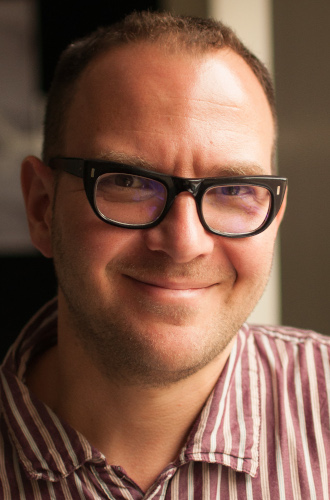
Doctorow has gone one better and sent us a photo of himself (r.) in the same pose.

Thanks, Cory!

Just to summarize, in his second PW piece Doctorow describes the challenge of getting audio versions of his books produced. His only condition is that he has to be satisfied, and that’s a bit of a problem, because Doctorow’s satisfaction quotient does not sit on the same coordinates as those by which the rest of us measure pleasure. Still, in chronicling his adventures in audioland he does not come off as unreasonable. To the contrary, his annoyance with proprietary restrictions, generically known as “DRM” – Digital Rights Management – is something that bothers e-book readers as well as audiophiles.

Doctorow’s quest for an ideal audio experience will benefit all of us and, we hope, enable producers to give customers better products and services.

Check out Can You Hear Me Now? and you’ll see what we mean.


Cory Doctorow’s Lovers Quarrel with Audio

Last month we reported that Cory Doctorow (that’s not he at the right) had launched a monthly column in Publishers Weekly dedicated to monitoring his venture into book publishing. “Doctorow, whose brash and sometimes subversive-sounding publishing strategies have made him a folk hero to his fans and generated intense controversy in the mainstream publishing community, has laid siege to the very ramparts of that community by wagering that he’s at least as good a publisher as they are,” we wrote. “Maybe, even, a better one. And he’s thrown down the gauntlet in the industry’s very own trade publication, Publishers Weekly.” You can read about it in What Publishers Can Learn from Cory Doctorow.

In his second essay, he describes the challenge of getting audio versions of his books produced. His only condition is that he has to be satisfied, and that’s a bit of a problem, because Doctorow’s satisfaction quotient does not sit on the same coordinates as those by which the rest of us measure pleasure. Still, in chronicling his adventures in audioland he does not come off as unreasonable. To the contrary, his annoyance with proprietary restrictions, generically known as “DRM” – Digital Rights Management – is something that bothers e-book readers as well as audiophiles.

Doctorow’s quest for an ideal audio experience will benefit all of us and, we hope, enable producers to give customers better products and services.

Check out Can You Hear Me Now? and you’ll see what we mean.

Richard Curtis

Every Blogger owes a debt of gratitude to newspapers and magazines. This posting relies on original research and reporting performed by Publishers Weekly.


What Can Publishers Learn from Cory Doctorow?

The short answer? Everything.

Doctorow, whose brash and sometimes subversive-sounding publishing strategies have made him a folk hero to his fans and generated intense controversy in the mainstream publishing community, has laid siege to the very ramparts of that community by wagering that he’s at least as good a publisher as they are. Maybe, even, a better one. And he’s thrown down the gauntlet in the industry’s very own trade publication, Publishers Weekly.

Doctorow describes his undertaking as an experiment. The book is a collection consisting almost completely of reprints of previously published stories. It’s called With a Little Help and it’s his third collection. “It will,” he declares, “be available for free on the day it is released.”

“Free” notwithstanding, what he hopes to accomplish is, simply, to make money publishing his book, or at least not lose any. He will achieve this by using the same contrarian (or at least counterintuitive) tactics that have succeeded with previous books, including giving them away.

How will we know if the experiment is a success or failure? Doctorow will chronicle it as it unfolds in a monthly column for PW, the first of which appeared in the October 19th issue. His entertaining article is a canny template for a publishing program that utilizes both print and digital media. Of course, this is something that every traditional publisher is trying to do, but here’s the problem with every traditional publisher: they’re all hobbled by a brick and mortar mindset (and overhead) that makes it impossible to achieve what one determined individual can do – at least, one bold and determined individual named Cory Doctorow. Though he acknowledges lots of help from his friends, he also, obviously, holds with Rudyard Kipling’s observation: “Down to Gehenna, or up to the Throne, He travels fastest who travels alone.”

Doctorow’s template for success includes:

  • Low overhead: My capital expenditures have to be as low as possible. In the ideal world, every object I make available will either cost nothing to produce or will be physically instantiated only after it has been ordered and paid for.
  • E-book: free, in a wide variety of formats: I have always released my books in three formats (text, HTML and PDF formatted for two-column portrait printout), and my readers have always followed up by converting them to an astonishing long tail of other formats for their preferred readers.
  • Audiobook: free, in a wide variety of formats: I’ve always taken great pleasure in reading my works aloud. I’ve done 150-plus installments of a podcast of me doing just that. But I’m no pro. However, many of my friends are pro voice actors, and I’ve called on them to each record one of the stories from the book.
  • Donations: whatever happens: I have never solicited donations for my works before, despite the urgings of True Believers who would like to see my publisher cut out of the loop, because I wanted to be sure my publisher was in the loop. This time around, I’m the publisher, so let’s see what people are interested in giving.
  • Print-on-Demand trade paperback: $16 (approximately; price TBD) Lulu.com produces beautiful books, objects that look every bit as good as the Lightning Source trade paperbacks that Ingram will sell you, provided you know what you’re doing when you design them. A designer, I am not. But John Berry, who designed my essay collection, Content, for Tachyon, is.
  • I’m also offering a custom-cover package for people running events or giveaways: for a setup fee (I’m thinking $300, but that’s not fixed in stone), I’ll sell you as many copies at Lulu’s cost as you’d like with your own cover on it.
  • Premium hardcover edition: $250, limited run of 250 copies:My office is in Clerkenwell, in London, close to several artisanal binders and some damned fine printers. My favorite binder is the venerable, family-owned Wyvern Bindery, which has agreed to bind a fine limited edition of With a Little Help for £20 a copy, in quantities of 20.
  • Commission a new story: $10,000 (one only):I probably underpriced this, but it’s too late now. The idea was to give my readers the chance to commission a story to be added to the collection at a later date—thus benefiting from an additional burst of publicity and possibly selling a second copy of the “expanded edition” to people who wanted to get the compleat text.
  • Advertisements: TBD: Since the paperbacks are print-on-demand, and the electronic files can be trivially modified, I’m going to sell a single ad unit on a time-limited basis: a half-page, or 500 pixels square, or five lines of text (depending on the image), at a price to be determined, in month-long increments.
  • Donations of books: TBD: Since the publication of Little Brother in spring 2008, I’ve run a donation program for my books wherein I ask librarians, teachers and people who work in other “worthy” institutions (halfway houses, shelters, hospitals, etc.) to put their names down for free copies. I publish this list online and mention it in the introductions to all the digital copies of the works.

Doctorow sometimes seems to have a chip on his shoulder, and some skeptics will try to knock it off. In fact blogger Michael Stackpole has spilled gallons of e-ink to do that very thing, including calling Doctorow a “snake-oil salesman” and his experiment “rubbish”. Entrenched establishmentarians will also try to take Doctorow down. That would be a mistake. They would be far better off studying his strategies and learning from them, something he makes easy to do with his wit and articulateness. I wish him not only to not lose money but to make a bundle. Maybe that will take the starch out of some publishers that are not just stuck in the last century but are proud of it.

Bravo to Publishers Weekly for offering Doctorow a forum. Read Doctorow’s Project: With a Little Help. I can’t wait to see how it all turns out.

Richard Curtis


When Did “Free” Become a Four Letter Word?

A popular tune reminds us that “The best things in life are free.” It lists among other benefits the moon, the stars, the flowers in spring and the robins that sing. Omitted from the lyrics is information, because there are a lot of people who don’t think free information is one of the best things in life. In fact “Free” has become one of the nastier four-letter words in the English language, or at least one of the most controversial.

Two authors, Chris Anderson and Cory Doctorow, have invested a good deal of their time (and ours) attempting to redefine free, not merely as an abstract concept but as a template for action. I’ll state my view upfront: I agree with economist Milton Friedman who said “There is no such thing as a free lunch.” Free always has a price, and anyone who believes otherwise will end up either paying it or sticking someone else with the bill. I will even go so far as to say this is an immutable law.

But read on and judge for yourself.

As digital media mature and the financial stakes in the e-book industry soar on a double-digit trajectory, a task force of businesspeople, entrepreneurs and managers, backed by righteously indignant writers, musicians and artists is confronting a generation of Web users that stubbornly refuses to pay for content.

Some members of this generation grew up with a strong sense of entitlement; some simply have little or no comprehension of copyright; still others, taking Robin Hood as their role model, deliberately and defiantly hack protected files or download pirated content to get around the law, asserting their right to liberate it from capitalist exploiters. And still others are, simply, thieves. They all march under the banner “INFORMATION WANTS TO BE FREE” or sport the “Copyleft” symbol displayed here (I’m not sure if Copyleft is copyrighted). Media news reports daily clashes with content providers tired of seeing the fruits of their creativity dissipated, given away or stolen.

The slogan, the movement and the tension between free and commercial date back to the dawn of the modern computer era, indeed to the dawn of copyright protection itself when the conflict between content creators and legitimate users (like scholars) was resolved in a complex body of law that governs intellectual property rights to this day.

Standing between these clashing armies is a contingent of men and women dedicated to understanding the relationship between content given away and content sold. Their observations – some scientific, some anecdotal – have begun to yield some thought-provoking hypotheses that might shape e-business strategies in the next generation. Few of them have as much to say as Chris Anderson, editor-in-chief of Wired and bestselling author of The Long Tail. Anderson’s book, Free: The Future of a Radical Price, has just been published, and an interview with him conducted by Publishers Weekly’s Andrew Richard Albanese reveals just how complex the word – and the concept – is. Free, Anderson states, is “a word with economic, psychological, historical meaning, a word with incredible misunderstanding and paradoxical diversions in definition.

The first thing that strikes you about the book’s title is its subtitle. Free is a price? That’s hard enough to absorb, but free as a radical price is a real head-scratcher.

Anderson says the definition of free as the opposite of paid is an artificial one. If it were not, how do we explain that people are making money giving products and services away? The answer is to view free as adding value to products that are offered for sale. We’ve often referred to the Gillette Razor model of giving away the razor but selling the blades. That concept can be applied to just about any product or service, and indeed that’s just what is happening. Anderson employs a word we’ve heard a lot of lately, “freemium,” meaning “using free to market paid.” The biggest misunderstanding of my work,” he tells Publishers Weekly, “is that I believe everything should be free. Not the case! Free should be a price point in the marketplace, but the free stuff should market the paid stuff.

You would think so. But as Malcolm Gladwell points out in his review of the book in The New Yorker, “…in the middle of laying out what he sees as the new business model of the digital age Anderson is forced to admit that one of his main case studies, YouTube, “has so far failed to make any money for Google.

“Why is that? Because of the very principles of Free that Anderson so energetically celebrates. When you let people upload and download as many videos as they want, lots of them will take you up on the offer. That’s the magic of Free psychology: an estimated seventy-five billion videos will be served up by YouTube this year. Although the magic of Free technology means that the cost of serving up each video is “close enough to free to round down,” “close enough to free” multiplied by seventy-five billion is still a very large number. A recent report by Credit Suisse estimates that YouTube’s bandwidth costs in 2009 will be three hundred and sixty million dollars. In the case of YouTube, the effects of technological Free and psychological Free work against each other.”

In other words, free is simply the glamorous side of capitalism that we prefer to see. But it’s really an illusion. In capitalism as in Newtonian physics, for every action there is an equal and opposite reaction. If you’re getting something free, someone else is paying for it.

Another name heard most frequently in connection with free is Cory Doctorow, the Canadian science fiction author, blogger and (depending on which side of the controversy you’re on) either a hero or a subversive. His articulate efforts to shake up the traditional publishing establishment have placed him on the leading edge of the digital paradigm shift. By putting his money where his mouth is he has singlehandedly altered our thinking about what works and what no longer works in the book industry.

Doctorow’s latest experimental venture exemplifies his philosophy. According to Locus, the trade publication of the fantasy and science fiction world, Doctorow’s latest short story collection, A Little Help, will be self-published in at least four different editions: “A free Creative Commons-licensed online edition in various formats; a free audio-book ‘featuring high-quality readings by a variety of voice-actor friends’; a print-on-demand trade paperback with five variant covers; and a limited edition hardcover to be sold in the $100-$250 range’…in batches of 10. The hardcover will feature bound-in SD cards or USB sticks including the e-book and audiobooks, and unique-to-each-volume endpapers made of signed and annotated paper ephemera by Doctorow’s writer friends,” Locus reports.

He will also produce a “super-premium” edition of one copy, including a story written specifically for the purchaser, for $10,000 (don’t bother, it’s already sold!). He will offer custom editions for conferences and other events with cover art of the organization’s choice, for a premium price. He will donate 10% of income from the book to Creative Commons, a non-profit organization dedicated to promoting the licensed sharing of creative works.

“There’re plenty of reasons to do this,” says Doctorow, “but for me, the most interesting one is the ability to empirically test some of the oft- bandied hypotheses about 21st century publication, the spectrum that runs from ‘Self-publication is a narcissistic money-pit that absorbs your time and money without returning as much as a real publishing deal could’ to ‘Publishers are obsolete dinosaurs and writers can do just as well going it alone.’”

Though some of this sounds positively Marxo-communo-anarcho-iconoclasto (Wikipedia says his parents were Trotskyist activists and he campaigned for nuclear disarmament and Greenpeace as a child), we cannot overlook the good old capitalistic enterprise underlying his experiment. By interweaving free and paid – freemium – Cory Doctorow is the poster child for Chris Anderson’s theories.

Richard Curtis


  • 2012 (144)
  • 2011 (436)
  • 2010 (489)
  • 2009 (597)
  • 2008 (294)
  • 2007 (64)
  • 2004 (3)